
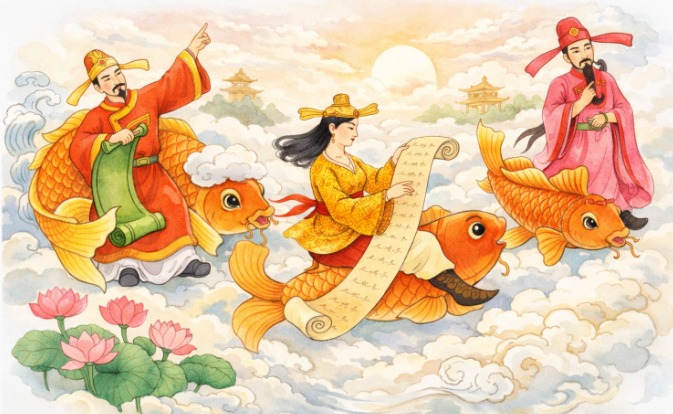
Last Thursday, February 12th—the 23rd day of the Lunar December—marked Kitchen God Day in Vietnamese culture. Unlike the distant gods of mountains or rivers who belong to the community , Kitchen Gods are household deities. They live in the kitchen, witnessing the raw truth of our daily lives behind closed doors as invisible observers.
On this day, families prepare delicacies and release three live fish to bid farewell to these deities as they journey to heaven. For one week, from 23rd to 30th of the Lunar December, they report to the Jade Emperor, recounting every good deed and bad behavior from the past year. Based on this status report, the family’s fortune for the coming year is decided.
Actually, this concept isn’t unique to Vietnam. Whether it’s children believing Santa Claus knows if they’ve been “naughty or nice,” or the all-seeing divine presence found in Christianity, Islam, and Buddhism. Across cultures and centuries, these “invisible observers” have served as the ultimate moral compass, guiding our behavior when no one else is around. It reflects that humanity has long embraced a shared truth: We behave better when we believe someone is watching.
Today, the internet is an essential part of our reality. However, the virtual world creates distance; distance creates detachment; and detachment weakens empathy. Cruelty becomes effortless. Cold comments, online bullying, and “cancel culture” spread like wildfire because we are typing behind a glass shield. Things people would never dare to say face-to-face are sent with a click. Because the consequences feel virtual, we forget that the impact—destroying reputations and suffering mental health—is very real. Did humans suddenly become worse? I don’t think so. Just no “invisible moral observers” in the virtual world. There is no Kitchen God in our browser; no Santa Claus in our comment section. Anonymity gives us the power of invisibility, and we feel unaccountable, our moral restraint declines.
Ironically, in reality, we are more “watched” now than ever before. Every click, search, and purchase is stored and analyzed. We have AI-integrated CCTV and smart devices that know our patterns better than we do. And in theory, this Big Data could function as a digital Kitchen God. AI systems can: Detect hate speech before it goes viral; Flag harassment in real-time; Identify coordinated abuse patterns. But there is a catch. Algorithms enforce platform rules, not morality. They struggle with nuance, context, and the messy complexity of human culture. However, many believe that more powerful machines, more data, and more hours of training will eventually overcome those challenges.
Then there comes the biggest concern: if Big Data is our new deity, who owns the heavens? Tech giants like Meta, Amazon, and Google… —corporations where profit is the highest priority. Unlike the Kitchen Gods of folklore, it was designed to make us better people; tech giants’ observation power is designed to make us bigger consumers.
Even though it sounds like a powerless situation, I believe the ultimate power of education and love can make it work. Through education, we can teach responsibility and remind ourselves that words have consequences both in the physical and virtual worlds. Through genuine interaction, we can bridge the distance that creates detachment. And through love put into action — in the way we speak, respond, and engage — we can bring the spirit of the Kitchen God back to our screens by ourselves. Because in the end, technology may watch us but only we can choose who we become.
(担当:Kiwi)
先週の木曜日、2月12日(旧暦12月23日)は、ベトナム文化における「かまどの神(Táo Quân)」の日でした。山や川の神のように共同体に属する遠い存在とは異なり、かまどの神は家庭の神です。台所に住み、目に見えない観察者として、閉ざされた扉の向こうで営まれる私たちの日常のありのままの真実を見守っています。
この日、各家庭はごちそうを用意し、生きた魚を三匹放して、神々が天へ旅立つのを見送ります。旧暦12月23日から30日までの一週間、彼らは天帝に報告を行い、この一年の善行と悪行のすべてを語ります。その報告に基づき、来年の家族の運勢が決まるとされています。
実は、この考え方はベトナム特有のものではありません。子どもたちが「いい子か悪い子か」をサンタクロースに見られていると信じること、あるいはキリスト教・イスラム教・仏教に見られる全知の神の存在など、文化や時代を超えて、こうした「目に見えない観察者」は道徳の羅針盤として機能してきました。それは、人間が長い歴史の中で共有してきたひとつの真実を示しています。「誰かに見られている」と信じるとき、私たちはよりよく振る舞う、ということです。
今日、インターネットは私たちの現実に欠かせない存在です。しかし、仮想世界は距離を生み、その距離は心の隔たりをを生み、隔たりは共感を弱めます。その結果、残酷さが簡単に生まれてしまうのです。
冷たいコメントやネットいじめ、いわゆる「キャンセル・カルチャー」は、画面の向こう側からタイピングすることで瞬く間に広がります。対面では決して口にしない言葉も、クリックひとつで送信されます。結果が「バーチャル」に感じられるために、評判を傷つけたり、心を深く傷つけたりという影響が極めて現実的であることを、私たちは忘れてしまうのです。
人間は急に悪くなったのでしょうか。私はそうは思いません。ただ、仮想世界には「目に見えない道徳の観察者」がいないのです。ブラウザにかまどの神はおらず、コメント欄にサンタクロースもいません。匿名性は私たちに透明になる力を与え、責任感を薄れさせ、道徳的抑制を低下させます。
皮肉なことに、現実では私たちはかつてないほど「監視」されています。あらゆるクリック、検索、購入履歴は保存され、分析されています。AIと統合された監視カメラやスマートデバイスは、私たち自身よりも私たちの行動パターンをよく知っています。
理論上、このビッグデータはデジタル時代のかまどの神として機能し得るでしょう。AIシステムは、ヘイトスピーチが拡散する前に検知し、嫌がらせをリアルタイムで警告し、組織的な攻撃パターンを特定することができます。
しかし問題があります。アルゴリズムが執行するのはプラットフォームの規則であって、道徳そのものではありません。文脈やニュアンス、人間文化の複雑さを理解することに苦戦します。それでも、多くの人は、より強力な機械、より多くのデータ、より長い学習時間によって、いずれその課題は克服されると信じています。
そして最大の懸念が生まれます。もしビッグデータが新たな神となるなら、天を所有するのは誰なのでしょうか。Meta、Amazon、Googleなどのテック企業です。民間伝承におけるかまどの神が人をより良くするための存在だったのに対し、テック企業の観察力は、私たちをより大きな消費者にするために設計されています。
無力に聞こえるかもしれませんが、私は教育と愛にこそ究極の力があると信じています。教育を通じて、私たちは責任を教え、言葉には現実世界でも仮想世界でも結果が伴うことを思い出させることができます。真の対話を通じて、切り離しを生む距離を埋めることができます。そして、話し方や応答の仕方、関わり方に愛を込めて行動することで、私たち自身の手で、かまどの神の精神をスクリーンの中に取り戻すことができるのです。なぜなら、最終的に、テクノロジーは私たちを監視できても、どのような人間になるかを選ぶのは、私たち自身だからです。